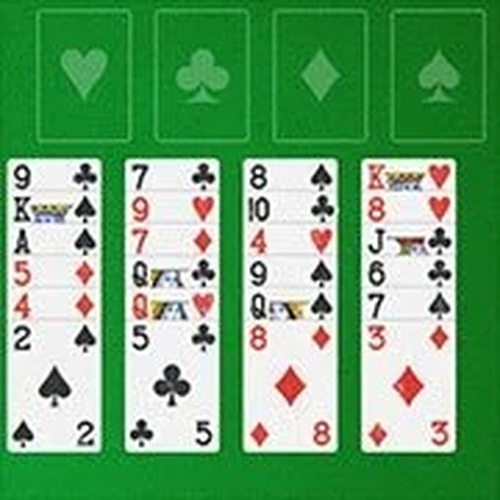
This version of Freecell stands out for its practical design choice of larger cards, which genuinely improves the experience on mobile devices. The core puzzle remains satisfyingly strategic, requiring careful sequencing and free cell management. The lack of time pressure allows for relaxed problem-solving. It is a clean, well-executed take on a classic card puzzle that prioritizes accessibility and thoughtful play over flashy features.
The game begins with a standard 52-card deck arranged into eight tableau piles. The first four piles contain seven cards each, while the remaining four piles hold six cards each. Four empty foundation slots and four free cells are positioned at the top. This setup creates a clear starting point for strategic play.
Players move cards between tableau piles by building descending sequences of alternating colors. For instance, a red five can be placed on a black six. The four free cells serve as temporary storage, each holding one card at a time. Foundations must be built by suit from Ace to King. Empty tableau piles can receive any card, offering flexibility.
The most notable feature is the enlarged card size, which reduces eye strain and improves touch interaction on smaller screens. This design choice makes the game more accessible for players who find standard card sizes difficult to read or tap accurately. The interface remains uncluttered, focusing attention on the puzzle itself.
Success depends on careful planning and foresight. Players must decide when to use free cells, how to sequence moves, and which cards to prioritize. There is no timer, allowing for thoughtful deliberation. The game encourages logical reasoning and pattern recognition without rushing the player.
This version of Freecell is suitable for all ages. The absence of time pressure makes it ideal for casual sessions. The puzzle can be paused and resumed at any point. It provides a mental workout that feels satisfying rather than stressful.








Comments
0 comments